Origin-
In pre-industrial times, there is evidence of scrap bronze and other metals being collected in Europe and melted down for perpetual reuse. Paper recycling was first recorded in 1031, when Japanese shops sold repulped paper. In Britain dust and ash from wood and coal fires was collected by "dustmen" and downcycled as a base material used in brick making. The main driver for these types of recycling was the economic advantage of obtaining recycled feedstock instead of acquiring virgin material, as well as a lack of public waste removal in ever more densely populated areas. In 1813, Benjamin Law developed the process of turning rags into "shoddy" and "mungo" wool in Batley, Yorkshire. This material combined recycled fibers with virgin wool. The West Yorkshire shoddy industry in towns such as Batley and Dewsbury, lasted from the early 19th century to at least 1914.
Industrialization spurred demand for affordable materials; aside from rags, ferrousscrap metals were coveted as they were cheaper to acquire than virgin ore. Railroads both purchased and sold scrap metal in the 19th century, and the growing steel and automobile industries purchased scrap in the early 20th century. Many secondary goods were collected, processed and sold by peddlers who scoured dumps and city streets for discarded machinery, pots, pans and other sources of metal. By World War I, thousands of such peddlers roamed the streets of American cities, taking advantage of market forces to recycle post-consumer materials back into industrial production.
Beverage bottles were recycled with a refundable deposit at some drink manufacturers in Great Britain and Ireland around 1800, notably Schweppes. An official recycling system with refundable deposits was established in Sweden for bottles in 1884 and aluminum beverage cans in 1982; the law led to a recycling rate for beverage containers of 84–99 percent depending on type, and a glass bottle can be refilled over 20 times on average.
For a recycling program to work, having a large, stable supply of recyclable material is crucial. Three legislative options have been used to create such a supply: mandatory recycling collection, container deposit legislation and refuse bans. Mandatory collection laws set recycling targets for cities to aim for, usually in the form that a certain percentage of a material must be diverted from the city's waste stream by a target date. The city is then responsible for working to meet this target.
Container deposit legislation involves offering a refund for the return of certain containers, typically glass, plastic and metal. When a product in such a container is purchased, a small surcharge is added to the price. This surcharge can be reclaimed by the consumer if the container is returned to a collection point. These programs have been very successful, often resulting in an 80 percent recycling rate. Despite such good results, the shift in collection costs from local government to industry and consumers has created strong opposition to the creation of such programs in some areas. A variation on this is where the manufacturer bears responsibility for the recycling of their goods. In the European Union, the WEEE Directive requires producers of consumer electronics to reimburse the recyclers' costs.
An alternative way to increase supply of recyclates is to ban the disposal of certain materials as waste, often including used oil, old batteries, tires and garden waste. One aim of this method is to create a viable economy for proper disposal of banned products. Care must be taken that enough of these recycling services exist, or such bans simply lead to increasedillegal dumping.

Government-mandated demand-
Legislation has also been used to increase and maintain a demand for recycled materials. Four methods of such legislation exist: minimum recycled content mandates, utilization rates, procurement policies and recycled product labeling.
Both minimum recycled content mandates and utilization rates increase demand directly by forcing manufacturers to include recycling in their operations. Content mandates specify that a certain percentage of a new product must consist of recycled material. Utilization rates are a more flexible option: industries are permitted to meet the recycling targets at any point of their operation or even contract recycling out in exchange for tradeable credits. Opponents to both of these methods point to the large increase in reporting requirements they impose, and claim that they rob industry of necessary flexibility.
Governments have used their own purchasing power to increase recycling demand through what are called "procurement policies." These policies are either "set-asides," which reserve a certain amount of spending solely towards recycled products, or "price preference" programs which provide a larger budget when recycled items are purchased. Additional regulations can target specific cases: in the United States, for example, the Environmental Protection Agency mandates the purchase of oil, paper, tires and building insulation from recycled or re-refined sources whenever possible.
The final government regulation towards increased demand is recycled product labeling. When producers are required to label their packaging with amount of recycled material in the product (including the packaging), consumers are better able to make educated choices. Consumers with sufficient buying power can then choose more environmentally conscious options, prompt producers to increase the amount of recycled material in their products, and indirectly increase demand. Standardized recycling labeling can also have a positive effect on supply of recyclates if the labeling includes information on how and where the product can be recycled.
Recyclates-
Recyclate is a raw material that is sent to, and processed in a waste recycling plant or materials recovery facility which will be used to form new products. The material is collected in various methods and delivered to a facility where it undergoes re-manufacturing so that it can used in the production of new materials or products. For example, plastic bottles that are collected can be re-used and made into plastic pellets, a new product.
The quality of recyclates is recognized as one of the principal challenges that needs to be addressed for the success of a long-term vision of a green economy and achieving zero waste. Recyclate quality is generally referring to how much of the raw material is made up of target material compared to the amount of non-target material and other non-recyclable material. Only target material is likely to be recycled, so a higher amount of non-target and non-recyclable material will reduce the quantity of recycling product. A high proportion of non-target and non-recyclable material can make it more difficult for re-processors to achieve "high-quality" recycling. If the recyclate is of poor quality, it is more likely to end up being down-cycled or, in more extreme cases, sent to other recovery options or landfilled. For example, to facilitate the re-manufacturing of clear glass products there are tight restrictions for colored glass going into the re-melt process.
The quality of recyclate not only supports high quality recycling, but it can also deliver significant environmental benefits by reducing, reusing and keeping products out of landfills. High quality recycling can help support growth in the economy by maximizing the economic value of the waste material collected. Higher income levels from the sale of quality recyclates can return value which can be significant to local governments, households and businesses. Pursuing high quality recycling can also provide consumer and business confidence in the waste and resource management sector and may encourage investment in that sector.
There are many actions along the recycling supply chain that can influence and affect the material quality of recyclate. It begins with the waste producers who place non-target and non-recyclable wastes in recycling collection. This can affect the quality of final recyclate streams or require further efforts to discard those materials at later stages in the recycling process. The different collection systems can result in different levels of contamination. Depending on which materials are collected together, extra effort is required to sort this material back into separate streams and can significantly reduce the quality of the final product. Transportation and the compaction of materials can make it more difficult to separate material back into separate waste streams. Sorting facilities are not one hundred per cent effective in separating materials, despite improvements in technology and quality recyclate which can see a loss in recyclate quality. The storage of materials outside where the product can become wet can cause problems for re-processors. Reprocessing facilities may require further sorting steps to further reduce the amount of non-target and non-recyclable material. Each action along the recycling path plays a part in the quality of recyclate.
Curbside Collection-
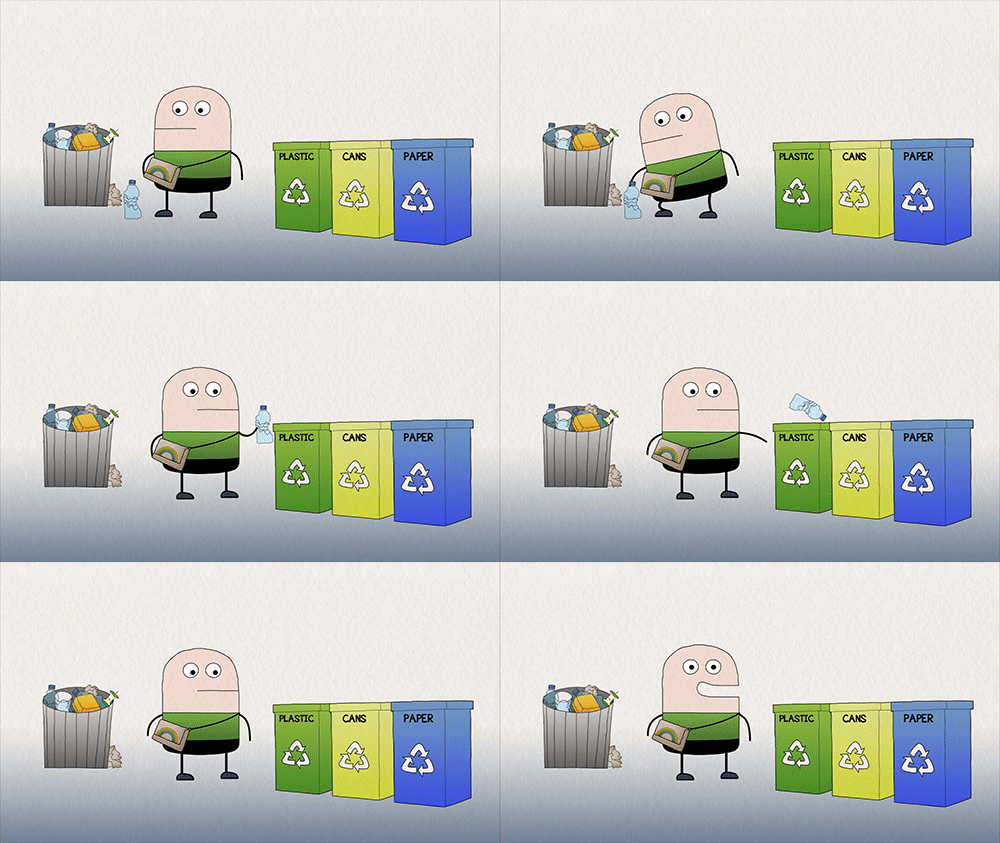
Curbside collection encompasses many subtly different systems, which differ mostly on where in the process the recyclates are sorted and cleaned. The main categories are mixed waste collection, commingled recyclables and source separation. A waste collection vehicle generally picks up the waste. At one end of the spectrum is mixed waste collection, in which all recyclates are collected mixed in with the rest of the waste, and the desired material is then sorted out and cleaned at a central sorting facility. This results in a large amount of recyclable waste, paper especially, being too soiled to reprocess, but has advantages as well: the city need not pay for a separate collection of recyclates and no public education is needed. Any changes to which materials are recyclable is easy to accommodate as all sorting happens in a central location.
In a commingled or single-stream system, all recyclables for collection are mixed but kept separate from other waste. This greatly reduces the need for post-collection cleaning but does require public education on what materials are recyclable.
Source separation is the other extreme, where each material is cleaned and sorted prior to collection. This method requires the least post-collection sorting and produces the purest recyclates, but incurs additional operating costs for collection of each separate material. An extensive public education program is also required, which must be successful if recyclate contamination is to be avoided.
Source separation used to be the preferred method due to the high sorting costs incurred by commingled (mixed waste) collection. Advances in sorting technology , however, have lowered this overhead substantially—many areas which had developed source separation programs have since switched to co-mingled collection.
Sorting-
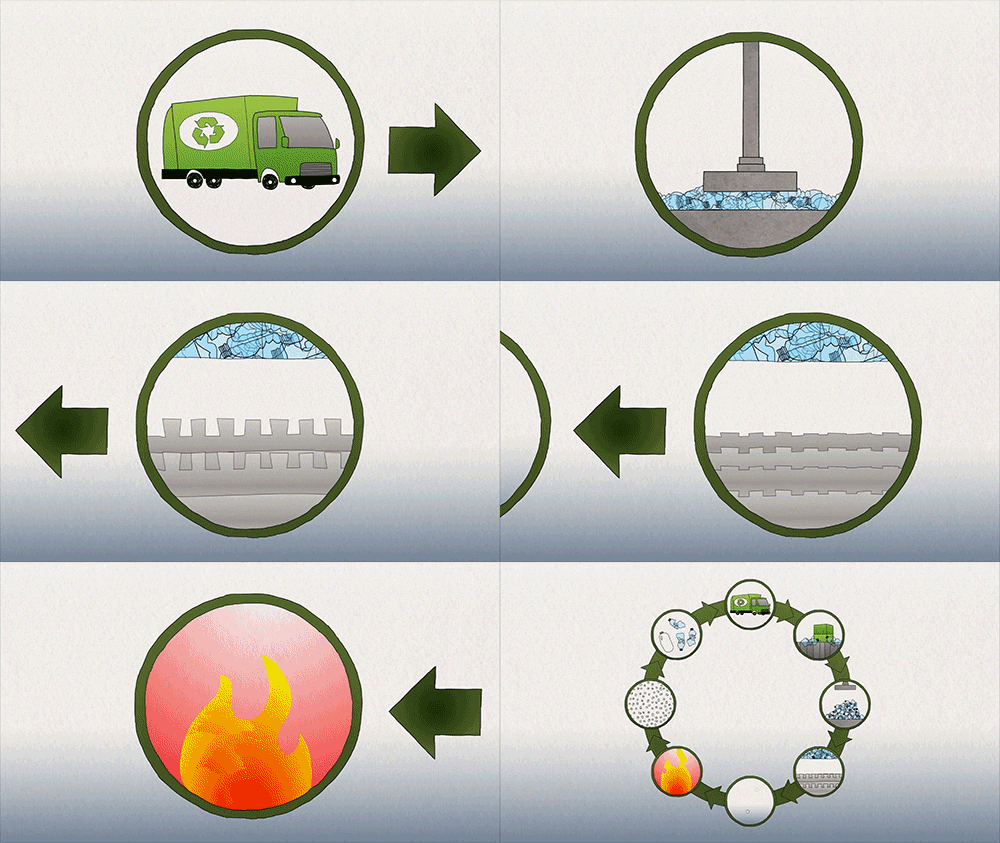
Once commingled recyclates are collected and delivered to a central collection facility, the different types of materials must be sorted. This is done in a series of stages, many of which involve automated processes such that a truckload of material can be fully sorted in less than an hour. Some plants can now sort the materials automatically, known as single-stream recycling. In plants, a variety of materials are sorted such as paper, different types of plastics, glass, metals, food scraps and most types of batteries. A 30 percent increase in recycling rates has been seen in the areas where these plants exist.
Initially, the commingled recyclates are removed from the collection vehicle and placed on a conveyor belt spread out in a single layer. Large pieces of corrugated fiberboard and plastic bags are removed by hand at this stage, as they can cause later machinery to jam.
Next, automated machinery such as disk screens and air classifiers separate the recyclates by weight, splitting lighter paper and plastic from heavier glass and metal. Cardboard is removed from the mixed paper and the most common types of plastic,PET (#1) and HDPE (#2), are collected. This separation is usually done by hand but has become automated in some sorting centers: a spectroscopic scanner is used to differentiate between different types of paper and plastic based on the absorbed wavelengths, and subsequently divert each material into the proper collection channel.
Strong magnets are used to separate out ferrous metals, such as iron, steel and tin cans. Non-ferrous metals are ejected by magnetic eddy currents in which a rotatingmagnetic field induces an electric current around the aluminum cans, which in turn creates a magnetic eddy current inside the cans. This magnetic eddy current is repulsed by a large magnetic field, and the cans are ejected from the rest of the recyclate stream.
Finally, glass is sorted according to its color: brown, amber, green or clear. It may either be sorted by hand, or via an automated machine that uses colored filters to detect different colors. Glass fragments smaller than 10 millimetres (0.39 in) across cannot be sorted automatically, and are mixed together as "glass fines."
This process of recycling as well as reusing the recycled material has proven advantageous because it reduces amount of waste sent to landfills, conserves natural resources, saves energy, reduces greenhouse gas emissions and helps create new jobs. Recycled materials can also be converted into new products that can be consumed again, such as paper, plastic and glass.
The City and County of San Francisco's Department of the Environment is attempting to achieve a city-wide goal of Zero Waste by 2020. San Francisco's refuse hauler, Recology, operates an effective recyclables sorting facility in San Francisco, which helped San Francisco reach a record-breaking diversion rate of 80%.
Recycling Industrial Waste-
Although many government programs are concentrated on recycling at home, a 64% of waste in the United Kingdom is generated by industry. The focus of many recycling programs done by industry is the cost–effectiveness of recycling. The ubiquitous nature of cardboard packaging makes cardboard a commonly recycled waste product by companies that deal heavily in packaged goods, like retail stores,warehouses and distributors of goods. Other industries deal in niche or specialized products, depending on the nature of the waste materials that are present.
The glass, lumber, wood pulp and paper manufacturers all deal directly in commonly recycled materials; however, old rubber tires may be collected and recycled by independent tire dealers for a profit.
Levels of metals recycling are generally low. In 2010, the International Resource Panel, hosted by the United Nations Environment Programme (UNEP) published reports on metal stocks that exist within society and their recycling rates.The Panel reported that the increase in the use of metals during the 20th and into the 21st century has led to a substantial shift in metal stocks from below ground to use in applications within society above ground. For example, the in-use stock of copper in the USA grew from 73 to 238 kg per capita between 1932 and 1999.
The report authors observed that, as metals are inherently recyclable, the metal stocks in society can serve as huge mines above ground (the term "urban mining" has been coined with this idea in mind). However, they found that the recycling rates of many metals are very low. The report warned that the recycling rates of some rare metals used in applications such as mobile phones, battery packs for hybrid cars and fuel cells, are so low that unless future end-of-life recycling rates are dramatically stepped up these critical metals will become unavailable for use in modern technology.
The military recycles some metals. The U.S. Navy's Ship Disposal Program uses ship breaking to reclaim the steel of old vessels. Ships may also be sunk to create anartificial reef. Uranium is a very dense metal that has qualities superior to lead andtitanium for many military and industrial uses. The uranium left over from processing it into nuclear weapons and fuel for nuclear reactors is called depleted uranium, and it is used by all branches of the U.S. military use for armour-piercing shells and shielding.
The construction industry may recycle concrete and old road surface pavement, selling their waste materials for profit.
Some industries, like the renewable energy industry and solar photovoltaictechnology in particular, are being proactive in setting up recycling policies even before there is considerable volume to their waste streams, anticipating future demand during their rapid growth.
Recycling of plastics is more difficult, as most programs are not able to reach the necessary level of quality. Recycling ofPVC often results in downcycling of the material, which means only products of lower quality standard can be made with the recycled material. A new approach which allows an equal level of quality is the Vinyloop process. It was used after theLondon Olympics 2012 to fulfill the PVC Policy.

Energy & Material Flows-
The amount of energy saved through recycling depends upon the material being recycled and the type of energy accounting that is used. Correct accounting for this saved energy can be accomplished with life-cycle analysis using real energy values. In addition, exergy, which is a measure of useful energy can be used. In general, it takes far less energy to produce a unit mass of recycled materials than it does to make the same mass of virgin materials.
Some scholars use emergy (spelled with an m) analysis, for example, budgets for the amount of energy of one kind (exergy) that is required to make or transform things into another kind of product or service. Emergy calculations take into account economics which can alter pure physics based results. Using emergy life-cycle analysis researchers have concluded that materials with large refining costs have the greatest potential for high recycle benefits. Moreover, the highest emergy efficiency accrues from systems geared toward material recycling, where materials are engineered to recycle back into their original form and purpose, followed by adaptive reuse systems where the materials are recycled into a different kind of product, and then by-product reuse systems where parts of the products are used to make an entirely different product.
The Energy Information Administration (EIA) states on its website that "a paper mill uses 40 percent less energy to make paper from recycled paper than it does to make paper from fresh lumber." Some critics argue that it takes more energy to produce recycled products than it does to dispose of them in traditional landfill methods, since the curbside collection of recyclables often requires a second waste truck. However, recycling proponents point out that a second timber or logging truck is eliminated when paper is collected for recycling, so the net energy consumption is the same. An Emergy life-cycle analysis on recycling revealed that fly ash, aluminum, recycled concrete aggregate, recycled plastic, and steel yield higher efficiency ratios, whereas the recycling of lumber generates the lowest recycle benefit ratio. Hence, the specific nature of the recycling process, the methods used to analyse the process, and the products involved affect the energy savings budgets.
It is difficult to determine the amount of energy consumed or produced in waste disposal processes in broader ecological terms, where causal relations dissipate into complex networks of material and energy flow. For example, "cities do not follow all the strategies of ecosystem development. Biogeochemical paths become fairly straight relative to wild ecosystems, with very reduced recycling, resulting in large flows of waste and low total energy efficiencies. By contrast, in wild ecosystems, one population's wastes are another population's resources, and succession results in efficient exploitation of available resources. However, even modernized cities may still be in the earliest stages of a succession that may take centuries or millennia to complete." How much energy is used in recycling also depends on the type of material being recycled and the process used to do so. Aluminium is generally agreed to use far less energy when recycled rather than being produced from scratch. The EPA states that "recycling aluminum cans, for example, saves 95 percent of the energy required to make the same amount of aluminum from its virgin source, bauxite." In 2009 more than half of all aluminium cans produced came from recycled aluminium.
Economist Steven Landsburg, author of a paper entitled "Why I Am Not an Environmentalist," has claimed that paper recycling actually reduces tree populations. He argues that because paper companies have incentives to replenish their forests, large demands for paper lead to large forests, while reduced demand for paper leads to fewer "farmed" forests.
When foresting companies cut down trees, more are planted in their place. Most paper comes from pulp forests grown specifically for paper production. Many environmentalists point out, however, that "farmed" forests are inferior to virgin forests in several ways. Farmed forests are not able to fix the soil as quickly as virgin forests, causing widespread soil erosion and often requiring large amounts of fertilizer to maintain while containing little tree and wild-lifebiodiversity compared to virgin forests. Also, the new trees planted are not as big as the trees that were cut down, and the argument that there will be "more trees" is not compelling to forestry advocates when they are counting saplings.
In particular, wood from tropical rainforests is rarely harvested for paper because of their heterogeneity. According to the United Nations Framework Convention on Climate Change secretariat, the overwhelming direct cause of deforestation is subsistence farming (48% of deforestation) and commercial agriculture (32%), which is linked to food, not paper production.

